
Longevity Peptides: The Science of Reclaiming Vitality and Extending Health Span
If you’re reading this, chances are you’re someone who takes your health seriously. You work hard, you move often, you invest in yourself—and you want to live not just longer, but better.
That’s where longevity peptides enter the conversation. These small but mighty amino acid chains are creating waves in regenerative and longevity medicine for their ability to support the body’s natural repair systems, enhance recovery, and optimize cellular function.
As a physician who has dedicated my career to helping patients maintain vitality and resilience, I’m always searching for therapies that bridge advanced science with the body’s own wisdom. Peptides do exactly that.
What Are Longevity Peptides?
Think of peptides as your body’s messengers. They’re short sequences of amino acids that tell cells what to do—repair this, regenerate that, produce more of this protein, calm that inflammation.
We naturally produce hundreds of peptides, but as we age, production slows and cellular communication weakens. The result? Slower recovery, reduced muscle tone, duller skin, metabolic changes, and a general decline in how we feel day to day.
Longevity peptides are designed to restore that communication. By mimicking or amplifying the body’s natural signals, they can encourage cells to repair, rejuvenate, and function more efficiently. In many ways, they help your body “remember” how to heal and renew itself.
How Longevity Peptides Work
Every peptide has a specific “target” in the body—a receptor it binds to, triggering a cascade of biological responses.
Some peptides influence growth hormone release, which supports muscle tone, recovery, and metabolism. Others act directly on mitochondria, the energy-producing centers of your cells, improving cellular energy and resilience. Some modulate inflammation and tissue repair, helping the body maintain balance rather than chronic low-grade inflammation (a key driver of aging).
I often describe peptides like a maintenance crew for your body. When we’re young, these crews are active and efficient. Over time, they slow down or miss repair signals. Longevity peptides act like skilled supervisors who retrain the crews—restoring rhythm, order, and communication so your system runs more smoothly.
Top Longevity Peptides Worth Knowing
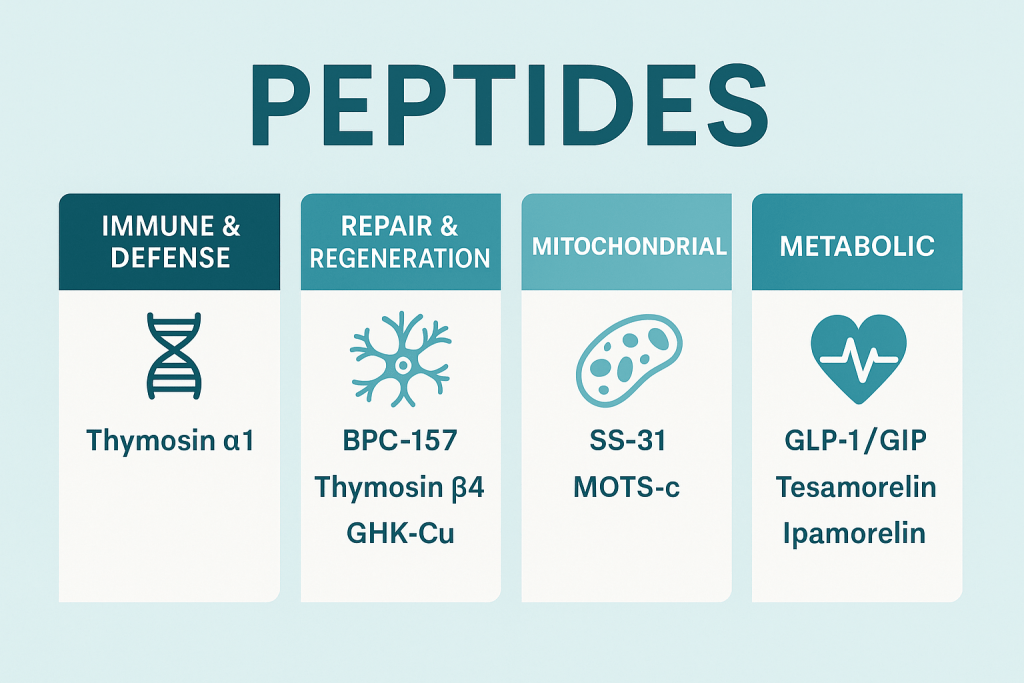
There are hundreds of peptides available today, but only a select few stand out for their impact on longevity, vitality, and repair. I like to think of them in families — each one supports a different pillar of health.
Below are the key categories I focus on most often in my practice:
Immune and Cellular Defense Peptides
Thymosin Alpha-1
This is one of the most powerful longevity peptides we have. Thymosin α-1 helps modulate the immune system—not by overstimulating it, but by improving balance and resilience. It enhances your body’s ability to identify and remove damaged or “senescent” cells, supports antiviral defense, and may help regulate chronic inflammation. As we age, immune efficiency declines; Thymosin α-1 helps restore that youthful precision.
Repair and Regeneration Peptides
BPC-157
Known as the “Body Protection Compound,” BPC-157 accelerates tissue repair, especially in the gut, tendons, ligaments, and muscle. It supports angiogenesis (formation of new blood vessels) and reduces inflammation—a remarkable ally for recovery and longevity.
Thymosin Beta-4 (TB-4)
TB-4 enhances cellular migration and regeneration, particularly within muscle and cardiac tissue. It’s often used to support wound healing and improve recovery from physical stress or surgery. Together, TB-4 and BPC-157 form a powerful repair duo.
GHK-Cu (Copper Tripeptide)
Originally discovered in human plasma, GHK-Cu promotes collagen and elastin synthesis, supports DNA repair, and exhibits strong antioxidant effects. It’s often called the “youth peptide” because of its benefits for skin integrity, hair growth, and cellular health.
Mitochondrial Optimization Peptides
SS-31 (Elamipretide)
SS-31 targets the mitochondria—the energy factories of your cells—to reduce oxidative stress and improve ATP production. By stabilizing the inner mitochondrial membrane, it enhances endurance, recovery, and resilience. Think of it as a tune-up for your cellular engines.
MOTS-c
Produced by mitochondria themselves, MOTS-c improves metabolic flexibility, enhances glucose utilization, and protects against stress-induced cellular damage. It’s gaining attention for its potential to extend lifespan and improve overall vitality.
Metabolic and Weight Optimization Peptides
GLP-1 / GIP
Often discussed as “weight-loss peptides,” GLP-1 (glucagon-like peptide-1) and GIP (glucose-dependent insulinotropic peptide) are far more than that. They help regulate blood sugar, reduce inflammation, and improve cardiovascular and brain health. These peptides may enhance satiety and insulin sensitivity while offering protective benefits for the heart, pancreas, and brain—making them truly transformative for longevity, not just aesthetics.
Growth and Recovery Peptides
Tesamorelin (Tesa) and Ipamorelin (Ipa)
Both Tesamorelin and Ipamorelin belong to the same peptide family as CJC-1295. They stimulate the body’s natural release of growth hormone, supporting lean muscle preservation, improved sleep, and recovery without overstimulating the endocrine system. When paired strategically, these peptides can help restore vitality and body composition in a way that feels natural and sustainable.
Where Longevity Meets Precision: Introducing NEO7
At Austin Regenerative Therapy, we take longevity science a step further through our partnership with Neo7Bioscience—a revolutionary platform at the intersection of genetics, AI, and regenerative medicine.
While most peptide protocols are designed from generalized data, NEO7 custom-engineers peptides based on your unique genome. Using long-read sequencing and advanced AI algorithms, NEO7 maps your genetic and metabolic pathways to design personalized peptides that repair cellular signaling, optimize mitochondrial performance, and correct gene expression errors.
NEO7 analyzes not just your genetics, but also your exposome—the environmental and lifestyle factors that influence how your genes express themselves over time. The result is a precision peptide protocol targeting the hallmarks of aging, from mitochondrial decline and inflammation to cellular senescence and metabolic inefficiency.
This is the future of peptide longevity—a completely individualized system that bridges genomics and regenerative medicine to enhance vitality, slow biological aging, and optimize the body’s repair systems at their source.
How Peptides Fit Into a Longevity Strategy

Peptides aren’t a magic bullet—they’re one tool within a comprehensive, whole-person longevity plan.
For my patients, I always begin with foundational pillars:
- Nutrition: nutrient-dense, anti-inflammatory eating with adequate protein.
- Movement: strength and cardiovascular training to preserve muscle and mitochondrial health.
- Sleep: your most powerful natural regenerative tool.
- Stress management: peptides can’t compensate for chronic cortisol elevation.
- Data-driven care: regular lab work and performance metrics to monitor progress.
Once these foundations are established, peptide therapy can be used strategically—to address specific hallmarks of aging such as mitochondrial decline, inflammation, or reduced cellular communication. This personalized approach helps us design a strategic peptide protocol, rather than a one-size-fits-all plan.
What to Expect: Realistic Outcomes and Timelines
With any regenerative therapy, consistency and patience matter. Peptides often work gradually, enhancing your biology over time rather than forcing a quick fix.
- Short term (4–8 weeks): improved recovery, sleep quality, subtle boost in energy or mood.
- Medium term (3–6 months): body composition shifts, better metabolic balance, enhanced skin tone and elasticity.
- Long term: improved resilience, faster repair from physical stress, and an overall sense of vitality and performance.
These outcomes vary widely—your genetics, lifestyle, and commitment to other longevity habits play a major role. Peptides can support your body’s potential, but they work best when partnered with healthy choices.
Safety, Sourcing, and Science-Based Use
When used under professional supervision, peptides are generally well-tolerated. The key is quality and customization.
I always advise verifying:
- Your peptides come from a pharmaceutical-grade, licensed compounding pharmacy.
- The protocol is personalized based on your goals, labs, and overall health.
- You are monitored throughout for dosage adjustments and safety.
Because research is still evolving, peptides should be viewed as part of an ongoing, evidence-informed journey. In my practice, I use therapies that I’ve tried and tested myself, tracking my own biomarkers before sharing them with patients. That’s how I know they can be integrated safely and effectively.
Common Misconceptions About Peptides
Myth: Peptides reverse aging completely.
Fact: They can support the body’s repair systems and slow aspects of biological aging, but aging itself is multifactorial and complex.
Myth: All peptides are “natural,” so safety isn’t an issue.
Fact: Purity, dosage, and source matter. Work only with reputable providers.
Myth: More is better.
Fact: Peptide signaling follows balance, not excess. Overuse can disrupt your body’s feedback systems.
Myth: Everyone responds the same.
Fact: Genetic and lifestyle differences mean peptide protocols must be individualized.
Frequently Asked Questions
What exactly are longevity peptides?
They are short amino acid chains that act as messengers to promote repair, regeneration, and balance in the body—supporting vitality and longevity.
Are longevity peptides safe?
When prescribed and monitored by a qualified professional using high-quality sources, they are generally well-tolerated. As with any therapy, safety depends on proper guidance and medical oversight.
How long before I notice changes?
Some notice benefits within weeks, while others take several months. Longevity is a long game—it’s about cumulative improvements over time.
Can peptides replace a healthy lifestyle?
Never. Peptides work best with lifestyle optimization—nutrition, exercise, sleep, and mindset are the foundation.
Are they FDA-approved?
Some peptides are approved for specific indications; others are used off-label based on scientific evidence and clinical experience. Always work with a provider who understands these nuances.
The Future of Longevity Medicine
Peptides represent one of the most exciting frontiers in personalized longevity medicine. They remind us that we can work with the body’s innate intelligence—enhancing communication, promoting repair, and supporting optimal function.
The ultimate goal isn’t to chase youth—it’s to sustain energy, focus, and resilience so you can keep doing what you love, for as long as possible.
You deserve a life marked not by limitation, but by vitality and possibility.
Here’s to living longer—and living wonderfully.
