
The Best Red Light Therapy? Why the Most Powerful Results Happen When Light Meets Cellular Intelligence.
If you’ve been exploring ways to elevate your vitality, enhance longevity, and support whole-body performance, red light therapy has probably crossed your radar. It’s one of the technologies I personally use and recommend because, when done correctly, this modality can meaningfully shift how your cells produce energy—without medications, downtime, or harsh interventions.
Today, I want to walk you through what red light therapy actually is, how it works on a cellular level, who benefits most, what’s myth vs. reality, and how at-home devices compare to clinical-grade treatments. Then I’ll introduce how, at ART, we go even further with a therapy stack called Photo Redox, weaving together red light with methylene blue, molecular hydrogen, antioxidants, and pulsed PEMF for deeper mitochondrial rejuvenation.
My goal is to give you a warm, clear, science-rooted explanation—so you can make a confident, informed choice about whether this is right for you.
What Is Red Light Therapy?
Red light therapy, sometimes called photobiomodulation (PBM), uses very specific wavelengths of red and near-infrared light (typically 630–660 nm and 810–850 nm) to stimulate cellular repair, reduce inflammation, and optimize mitochondrial function.
Think of it as charging the battery inside each of your cells.
These light wavelengths penetrate through the skin and interact with the powerhouse of the cell, the mitochondria, to improve how efficiently they create energy (ATP). More mitochondrial energy means better tissue healing, less inflammation, and overall enhanced cellular resilience.

Trusted sources:
- Harvard researcher Michael Hamblin’s extensive PBM work highlights its mechanisms and benefits.¹
- The National Institutes of Health identifies PBM as a safe, non-invasive modality that improves cellular metabolism and tissue repair.²
How Red Light Therapy Works
When red and near-infrared light reach your cells, something powerful happens:
1. Light stimulates cytochrome c oxidase (CCO)
This is an enzyme in the mitochondrial respiratory chain. When activated by red light, CCO releases nitric oxide and increases electron transport—boosting ATP production.³
2. It lowers oxidative stress
Red light doesn’t just “give energy”—it helps cells clean up metabolic waste, reducing inflammation and accelerating recovery.
3. It improves circulation and lymphatic flow
This supports better nutrient delivery, detoxification, and tissue oxygenation.
4. It promotes collagen and elastin synthesis
This is why red light is beloved for skin rejuvenation.
You can think of it as creating a more youthful, energized profile for your cells, helping tissues behave younger and function more efficiently.
Benefits of Red Light Therapy
Not all benefits matter equally to every patient, so I approach this from a whole-person, personalized lens. However, these are the most well-documented and clinically relevant:
Cognitive & Mood Support
- Enhanced mitochondrial function in neurons
- Reduced neuroinflammation
- Improved performance in individuals with brain fog or concussion history
(Research supports PBM for cognitive improvement.⁴)
Skin Health & Aesthetics
- Increased collagen, firmness, and elasticity
- Reduced fine lines and wrinkles
- Improved scar and wound healing

Inflammation & Pain Reduction
- Reduced joint pain
- Accelerated recovery after workouts
- Support for chronic inflammation conditions
Performance & Recovery
- Faster muscle recovery
- Increased strength output when used pre-training
- Enhanced ATP availability
Energy & Metabolic Function
- Reduced fatigue
- Improved mitochondrial efficiency
- Better cellular resilience under stress
Does Red Light Therapy Actually Work?
Yes—when delivered at the right dose and wavelength.
This is where many misconceptions come in.
The scientific community broadly recognizes red light therapy as effective for improving tissue repair, reducing inflammation, and enhancing mitochondrial function.⁵
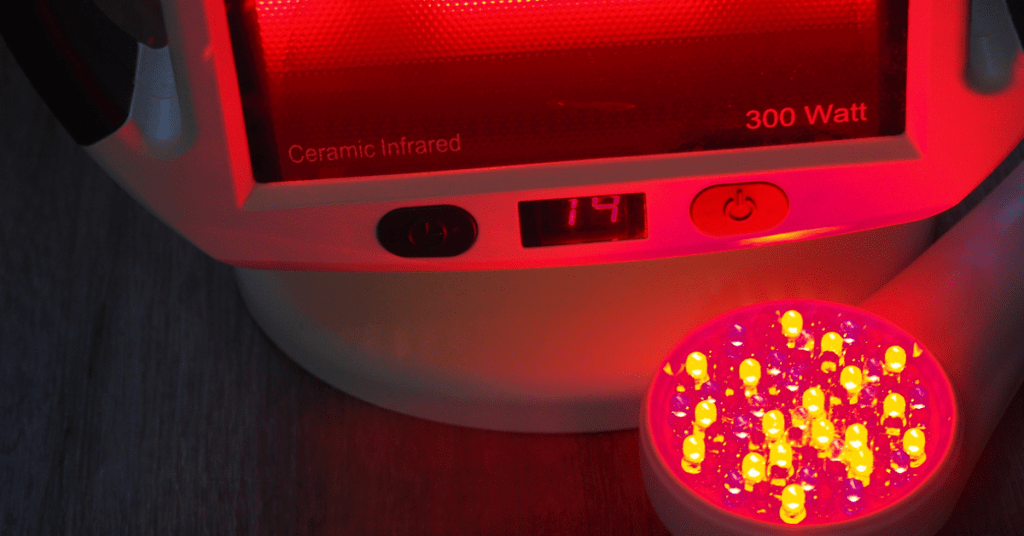
The challenge is that not all devices deliver therapeutic-level irradiance, and dosing matters tremendously.
Is Red Light Therapy Safe?
When performed correctly, PBM is considered very safe, with a strong safety profile across hundreds of studies.
Noteworthy points:
- It’s non-invasive
- It does not burn the skin
- It does not contain UV radiation
- Side effects are rare and mild (temporary redness or warmth)
This is one modality I use personally because it fits beautifully into a preventative, longevity-focused lifestyle with minimal downside.
At-Home Devices vs. Clinical-Grade Red Light
This is one of the most common questions I hear.
At-Home Devices
- Convenient but often underpowered
- May not penetrate deeply enough for systemic results
- Great for maintenance or skin-focused goals
- Perfect for daily use if expectations are realistic
Clinical Red Light Therapy
- Higher irradiance and deeper penetration
- More precise wavelength targeting
- More profound mitochondrial benefits
- Suitable for performance, inflammation reduction, and cellular repair
- Supervised dosing to avoid overstimulation
In short:
Home devices are helpful, but clinical treatments create more significant biological change—particularly for brain health, joint pain, and deep-tissue rejuvenation.
The ART Difference: Our Photo Redox Stack

At ART, we rarely rely on one therapy in isolation. When it comes to optimizing mitochondrial function and enhancing whole-person vitality, we lean into synergy.
Our Photo Redox Stack combines:
✔ Red Light Therapy
Stimulates mitochondrial energy and cellular repair.
✔ Methylene Blue
Acts as a mitochondrial electron donor to further enhance ATP production. It also functions as a potent antioxidant. (I personally use and test every methylene blue formulation before offering it to patients.)
✔ Molecular Hydrogen
Reduces oxidative stress and selectively neutralizes the most harmful free radicals.⁶
✔ Targeted Antioxidants
Support cellular detoxification and repair pathways.
✔ Pulsed PEMF (Pulsed Electromagnetic Field Therapy)
Enhances ion channel signaling, circulation, and tissue oxygenation—making cells more responsive to red light.
Why this matters:
Each component elevates the others, creating an environment where the body can repair, recharge, and reboot. This combination is especially impactful for:
- Chronic fatigue
- Cognitive decline or brain fog
- High-performance individuals looking for faster recovery
- Early signs of aging or mitochondrial dysfunction
- Patients seeking non-pharmaceutical anti-inflammatory support
I’ve found that this stacked approach provides a level of vitality and cellular energy you simply cannot achieve with red light alone.
Who Can Benefit Most From Red Light Therapy?
✔ High-performing professionals managing stress and cognitive load
✔ Individuals with early signs of aging
✔ Active people struggling with recovery or inflammation
✔ Those experiencing chronic fatigue or low energy
✔ Patients wanting a non-invasive, side-effect-free longevity tool
✔ Anyone looking to optimize mitochondrial function for long-term healthspan
Whether your goal is to feel sharper, recover faster, or age more youthfully, red light therapy can be a wonderful foundational tool—especially when used in a carefully curated therapeutic environment.
Final Thoughts
Red light therapy is not magic—and it’s not meant to be.
It’s biology, amplified by thoughtful application and precision.
When used strategically, especially in a clinical setting or combined with mitochondrial-enhancing compounds, it becomes one of the most effective, elegant tools for enhancing energy, longevity, and whole-person wellness.
If you’re curious whether this could help you reclaim your vitality, improve performance, or address deeper mitochondrial dysfunction, I’d be honored to guide you.
Sources
- Hamblin, M. R. (2017). Mechanisms and applications of photobiomodulation. AIMS Biophysics.
- National Institutes of Health. Photobiomodulation overview.
- Karu, T. (1999). Primary and secondary mechanisms of action of visible to near-IR radiation on cells. J Photochem Photobiol B.
- Naeser, M. et al. (2014). PBM for cognitive improvement. Photomed Laser Surg.
- Huang, Y. et al. (2011). Biphasic dose response in low-level light therapy. Dose-Response.
- Ohta, S. (2014). Molecular hydrogen as a therapeutic antioxidant. Medical Gas Research.
