
David Sinclair’s ER-100 Clinical Trial: First Human Data on Glaucoma and Epigenetic Reprogramming

Protecting your vision means protecting the freedom to read, drive, travel, and enjoy the people and activities you love. That is why a new clinical trial in glaucoma is drawing attention far beyond eye care.
On June 9, 2026, Life Biosciences, co-founded by Harvard Medical School geneticist Dr. David Sinclair, announced that the first participant had been dosed in its Phase 1 trial of ER-100. This investigational gene therapy applies partial epigenetic reprogramming to damaged cells involved in vision. [1]
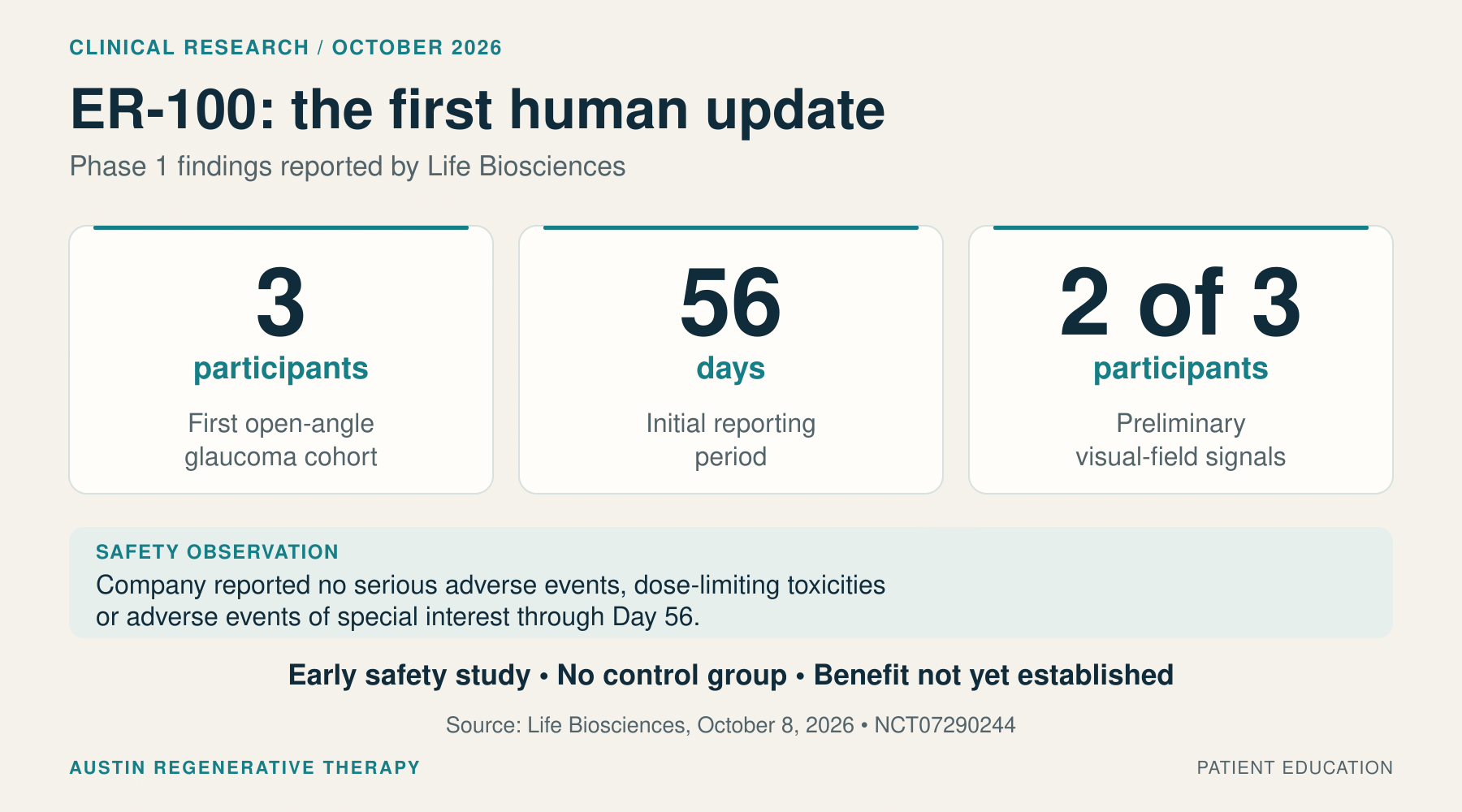
On October 8, 2026, the company reported early findings from the first three participants with open-angle glaucoma: treatment was well tolerated through Day 56, and two participants showed preliminary improvements on visual-field testing. [2]
At Austin Regenerative Therapy, we follow advances like this because they could expand what medicine can do to preserve function as we age. ER-100 remains investigational, and its ability to restore vision or reverse aging in humans has not been established.
What Is ER-100 and How Does It Work?
ER-100 is an investigational gene therapy designed to improve the function of retinal ganglion cells. These nerve cells help carry visual information from the eye to the brain and are damaged in diseases such as open-angle glaucoma and non-arteritic anterior ischemic optic neuropathy, or NAION. [1]
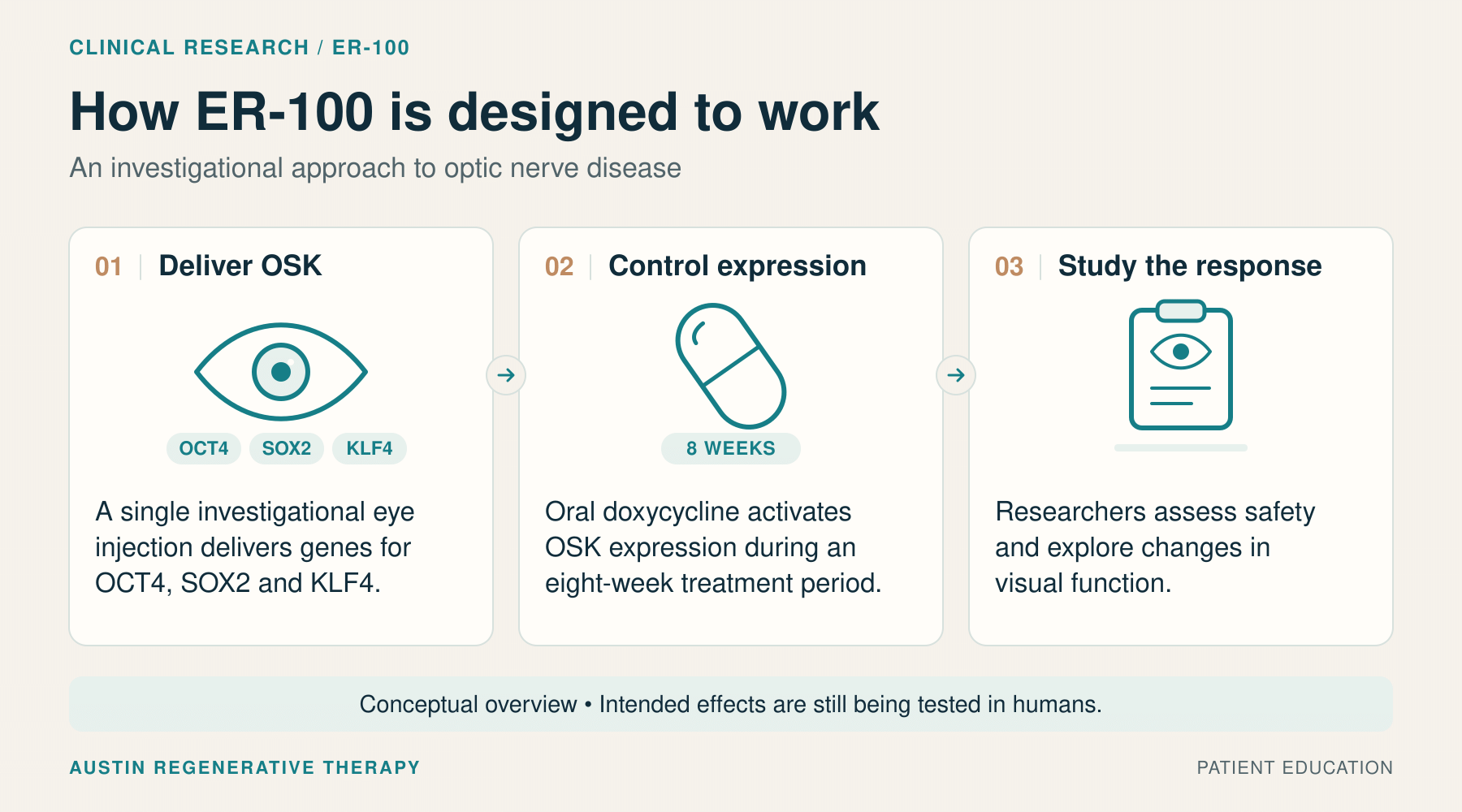
Through a single injection into the eye, ER-100 delivers genetic instructions for three transcription factors: OCT4, SOX2, and KLF4, collectively called OSK. These factors regulate gene activity. The aim is to restore more youthful patterns of cellular function while preserving the cells’ identity. [1]
In the trial, oral doxycycline activates OSK expression for eight weeks. This controlled approach is intended to limit reprogramming. Whether it provides lasting benefit with acceptable long-term safety in people remains under investigation. [2]
The Science Behind It: The Information Theory of Aging
Think of DNA as a cell’s instruction book and the epigenome as the system that helps the cell decide which instructions to use. Epigenetic marks help regulate gene activity and maintain a cell’s specialized identity.
Sinclair and colleagues propose that the progressive loss of this epigenetic information contributes to aging. Their Information Theory of Aging suggests that restoring aspects of this information might improve the function of aged or damaged tissues. It is a research framework, not a settled explanation of all human aging. [4]
In a 2020 study published in Nature, researchers reported that OSK expression improved visual function in mouse models of glaucoma and aging, restored more youthful DNA-methylation patterns, and promoted axon regeneration after optic-nerve injury. These animal findings helped establish the rationale for human testing; they do not prove the same benefits in patients. [5]
Phase 1 Trial: What the October 2026 Update Reported
The ongoing study, NCT07290244, is an open-label Phase 1 trial focused primarily on safety and tolerability. It plans to enroll up to 18 participants with open-angle glaucoma or NAION. [3]
According to Life Biosciences’ October 8 interim announcement:
- Three participants with open-angle glaucoma received the first dose level, 2 × 10¹¹ viral genomes, with oral doxycycline.
- Through Day 56, the company reported no dose-limiting toxicities, serious adverse events, or adverse events of special interest. Other reported adverse events were attributed to the procedure, steroids, or pre-existing conditions.
- Two of three participants showed preliminary improvements on Humphrey Visual Field testing. In each of these two participants, at least 28% of tested locations improved by more than 4 decibels.
- The independent monitoring board recommended escalation to the next dose level, 6 × 10¹¹ viral genomes. [2]
The key distinction: 28% refers to the proportion of tested visual-field locations with improved sensitivity. It does not mean a 28% improvement in overall vision.
These findings are encouraging, but three participants and 56 days cannot establish long-term safety or effectiveness. The study has no control group, and the changes do not establish biological rejuvenation. Larger studies and longer follow-up will be needed to determine whether the treatment delivers a meaningful, lasting benefit.
Why This Matters for Vision and Longevity
Current glaucoma treatments—including eye drops, laser procedures, and surgery—primarily lower eye pressure to help protect the optic nerve. They can help prevent further damage but do not undo vision loss that has already occurred. [6]
ER-100 is exploring whether changing the biology of damaged cells could improve their function. If controlled epigenetic reprogramming proves effective and acceptably safe in humans, it could inform research into other age-related diseases. Its relevance to broader human longevity remains a research question.
Protecting the vision you have remains the priority. Keep regular eye examinations and continue prescribed glaucoma treatment. An experimental therapy is not a reason to delay established care. [6]
What Can You Do for Your Healthspan Today?
You do not need to wait for the next scientific breakthrough to take a more proactive approach to your health. At Austin Regenerative Therapy in Austin, Texas, Dr. Khanh Nguyen and the team build personalized plans around your goals, medical history, biomarkers, and daily habits.
Our concierge longevity programs bring together:
- Nutrition, exercise, sleep, and recovery strategies tailored to your life.
- Body-composition and fitness assessments, including VO₂ max, with ongoing tracking of relevant health measures.
- Metabolic and cardiovascular risk assessment, alongside hormone evaluation and treatment when medically indicated.
- Individualized review of regenerative options, with attention to the evidence for the specific treatment and goal.
Our practice also evaluates approaches such as therapeutic plasma exchange (TPE), young plasma exchange (YPE), precision peptide protocols, VSEL-based treatments, exosome approaches, and NAD+ support. These options differ in their clinical evidence, regulatory status, and suitability. Several longevity applications remain investigational, and ER-100’s findings do not establish the effectiveness of these separate approaches.
For example, young donor plasma is not FDA-approved for treating aging or memory loss, and exosome treatments for longevity are not established therapies. These distinctions are part of an informed conversation about potential benefits, risks, and uncertainties. [7] [8]
Looking Ahead
The ER-100 trial raises an exciting question: can restoring aspects of a cell’s epigenetic information help preserve or recover function? The early findings justify continued study, while the questions of durable benefit and long-term safety remain open.
At Austin Regenerative Therapy, our goal is to help you stay strong, capable, and engaged in the life you want to live—with a plan that connects emerging science to your individual health priorities.
Ready to take a more proactive approach to aging?
Schedule a private consultation with Dr. Khanh Nguyen to explore a personalized strategy for your healthspan.
Austin Regenerative Therapy
6601 Vaught Ranch Rd, Suite 201
Austin, TX 78730
Phone: (512) 991-2560
Email: frontdesk@austinregen.com
Website: austinregen.com
ER-100 is an investigational therapy available only through clinical research and is not offered as routine treatment at Austin Regenerative Therapy. This article is for educational purposes and does not replace individualized medical or ophthalmic care. Treatment outcomes vary.
Sources
- Life Biosciences. First patient dosed in the Phase 1 ER-100 trial. June 9, 2026.
- Life Biosciences. First interim human data from the ER-100 trial. October 8, 2026.
- ClinicalTrials.gov. ER-100 study record, NCT07290244.
- Lu, Tian and Sinclair. The Information Theory of Aging. Nature Aging, 2023.
- Lu and colleagues. Reprogramming to recover youthful epigenetic information and restore vision. Nature, 2020.
- National Eye Institute. Glaucoma: diagnosis and treatment.
- FDA. Updated information about young donor plasma infusions. December 6, 2024.
- FDA. Consumer alert on regenerative medicine products, including stem cells and exosomes.
